From AI Potential to Pedagogical Decisions: Edul@b at the EODLW 2026 International Debate
The integration of artificial intelligence in education does not depend solely on technological possibilities, but also on the pedagogical decisions that guide its use. This issue was one of the focal points of the contribution by Marcelo Maina, professor at the Universitat Oberta de Catalunya (UOC) and researcher at the Edul@b Research Group, affiliated with the UOC-FuturEd research centre, during the European Open and Digital Learning Week (EODLW) 2026, held from 9 to 13 November.
Organised by EDEN Digital Learning Europe, EODLW reached its eleventh edition as an international forum for exchange among researchers, educators, practitioners, and policymakers interested in the transformation of digital education. The initiative is articulated in collaboration with other international networks, such as the United States Distance Learning Association (USDLA), the Flexible Learning Association of New Zealand (FLANZ), and the Open and Distance Learning Association of Australia (ODLAA), which promote parallel reflection and exchange activities across the Americas and the Asia-Pacific region.

An international debate on didactics in the age of artificial intelligence
Maina’s participation took place on 9 November in the webinar Questioning Digital Didactics: Rethinking Teaching, Learning and Assessment with AI, moderated by Estela Daukšienė, from Vytautas Magnus University (Lithuania) and member of the Management Board of EDEN Digital Learning Europe.

The session brought together researchers and specialists from Lithuania, Estonia, Catalonia, and the United States, with contributions from Giedrė Tamoliūnė, Airina Volungevičienė, and Patricija Škėmaitė, from Vytautas Magnus University; Janika Leoste, affiliated with Tallinn University and Tallinn University of Technology; Marcelo Maina, from the UOC; and Farah Bennani, affiliated with the USDLA.
From complementary perspectives, the webinar addressed the challenges posed by incorporating AI into teaching, learning, and assessment processes. Among the topics covered were the findings of the DI-daktika project, coordinated by Vytautas Magnus University, on digital didactics and artificial intelligence in school education; teacher agency and the competencies required to work with AI; the pedagogical foundations of its integration; and the frameworks and instruments that can guide its evidence-based use.
The various contributions shared a central concern: under what conditions AI can genuinely enhance teaching, learning, and assessment, and how to preserve the leading role of didactics and teachers’ professional judgement.
The subsequent discussion underscored the importance of safeguarding teacher autonomy and students’ critical thinking, deciding when AI adds pedagogical value, and evaluating its success based on real improvements in learning, rather than on the degree of technological adoption.
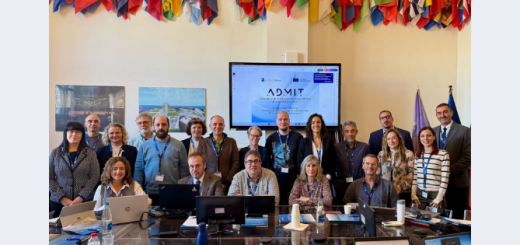
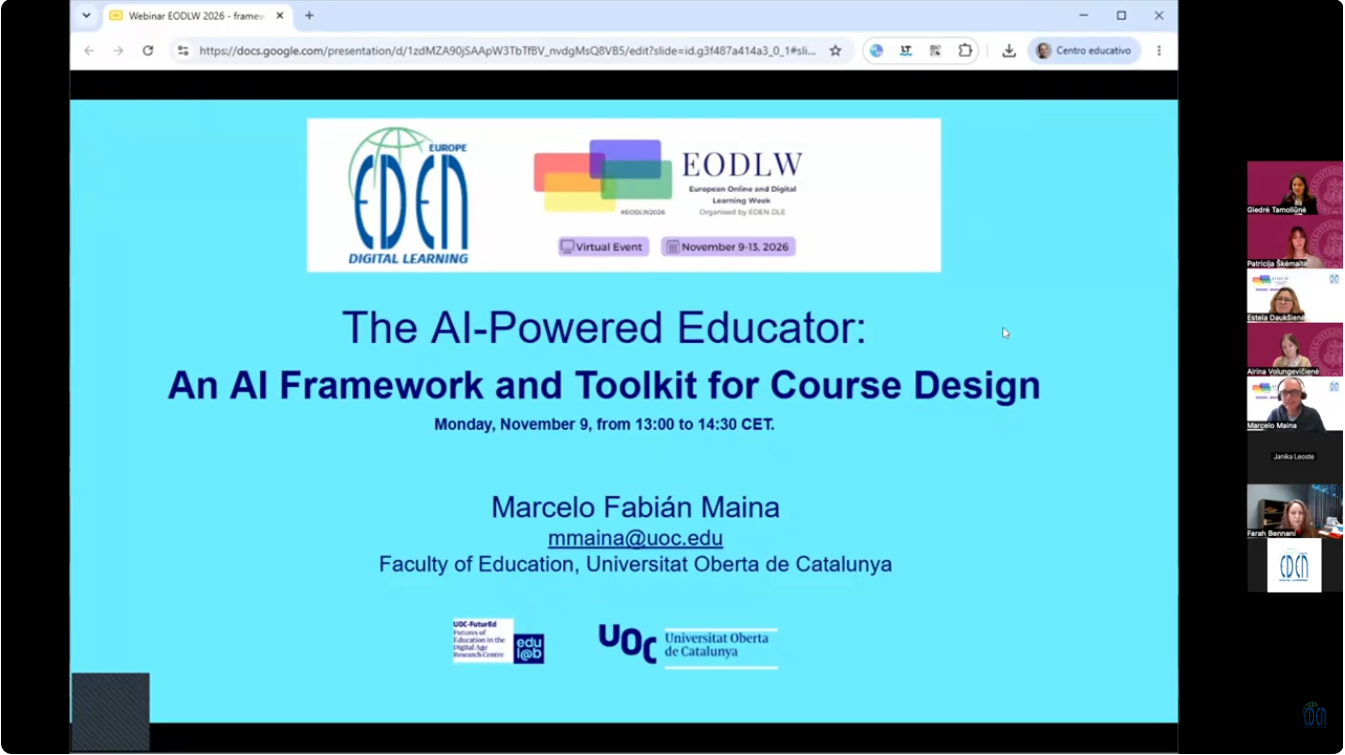
In this context, Maina delivered the presentation The AI-Powered Educator: An AI Framework and Toolkit for Course Design, focusing on a conceptual framework and a set of tools to guide the pedagogical, critical, and responsible use of generative AI in learning design. The proposal was developed within the framework of the European project ADMIT, co-funded by the Erasmus+ programme.
Rethinking learning design support
The presentation started from the growing demands for innovation, flexibility, and inclusion faced by educators, as well as the pressure on teaching and learning support centres, which have limited resources to offer personalised guidance. In this context, generative AI is framed as an opportunity to expand pedagogical support, enabling more flexible, exploratory, and iterative design processes.
To ground the proposal, the team analysed five well-established learning design models—ABC Learning Design, Carpe Diem, Iceberg, enABLe, and ELDeR—characterised by a solid pedagogical foundation, an orientation towards learning outcomes, and collaborative work. AI can help complement these methodologies, particularly in exploring alternatives and reviewing proposals, provided that educators’ pedagogical knowledge and critical judgement continue to guide decision-making.
A three-phase framework to guide collaboration between educators and AI
The ADMIT project has developed the AI-Assisted Learning Design Framework (AI-LD), which structures AI-assisted learning design into three interrelated phases:
- Analysis and planning: identifying needs, defining learning outcomes, and considering the context as well as ethical and regulatory requirements.
- Activity design: aligning learning outcomes, activities, and assessment, while incorporating feedback, reflection, and principles of inclusion.
- Development and production: creating and validating educational resources, ensuring their quality, accessibility, pedagogical suitability, and compliance with ethical and legal requirements.
Throughout the process, AI can contribute to analysis, generating alternatives, and producing resources, while educators retain responsibility for decisions and educational quality.
The framework, developed by Lourdes Guàrdia, Marcelo Maina, Nati Cabrera, Ludovica Fanni, and Alessandra Antonaci, is detailed in the LLM-ed framework report published in 2025.
From conceptual framework to practice: the AI-LD toolkit
To facilitate the application of the framework, the project has developed a toolkit, coordinated by Silke Wrede from FernUniversität in Hagen, which supports educators before, during, and after interacting with AI through three complementary instruments.
The Ethics & Compliance Check (ECC) allows educators to assess beforehand whether the intended use of AI is appropriate, taking into account legal requirements, institutional policies, data protection, and ethical principles. The AI-LD Protocol structures collaboration between educators and AI by defining objectives, roles, responsibilities, and validation criteria, with pedagogical guidance grounded in constructive alignment and Universal Design for Learning. Finally, Quality Safeguards supports the review of processes and outputs, verifying their quality, pedagogical coherence, and compliance with established requirements.
These instruments follow a shared logic: defining the conditions of use, coordinating collaboration with AI, and reviewing its quality.
Maina showcased an implementation of the toolkit as an interactive H5P book, which enables the documentation of decisions and facilitates flexible use of the instruments. The proposal is not tied to any specific language model and aims primarily to foster reflective practices and informed pedagogical decisions.
A research agenda on educational impact and teacher autonomy
The presentation concluded by identifying issues that require further empirical evidence, particularly whether AI-assisted designs genuinely improve learning outcomes, student engagement, and self-regulation.
It also highlighted the need to investigate which forms of human–AI collaboration foster better designs and how sustained use of these technologies may affect teachers’ professional judgement, creativity, and autonomy.
Resources for further learning
The presentation also referenced the free course GenAI in Education, available on AI Campus and developed within the framework of ADMIT.
The course offers resources to delve deeper into learning design with generative AI, rethink assessment, address student diversity, and tackle the ethical and institutional aspects of its integration. It incorporates the AI-LD framework and its toolkit, allowing participants to explore the content flexibly according to their individual needs and interests.
Maina’s contribution at EODLW 2026 thus places the debate on educational AI squarely in the realm of design decisions. Beyond the production and automation capabilities offered by these technologies, the proposal emphasises how to guide their use through pedagogical principles, clearly defined responsibilities, and processes of reflection and validation, as well as the need to continue researching their real effects on teaching and learning.