Professor Nikolaos Avouris visits Edul@b to foster synergies in educational AI, learning analytics, and digital transformation
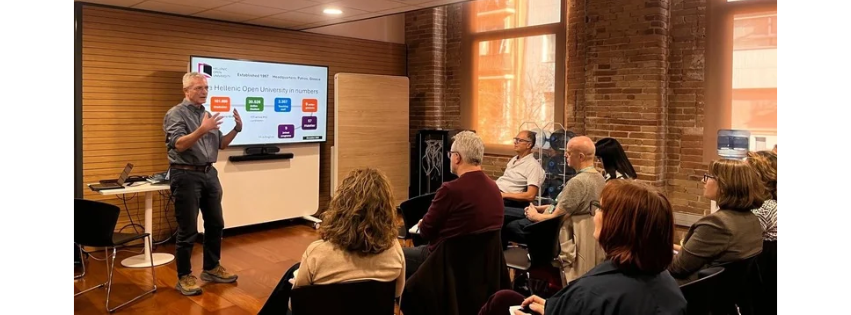
From November 16 to 19, 2026, the Edul@b research group, affiliated with the Futures of Education in the Digital Age Research Centre (UOC-FuturEd) at the Universitat Oberta de Catalunya, hosted Professor Nikolaos Avouris. Coordinated by researcher Marcelo Maina, this academic stay was structured around a series of activities aimed at strengthening international scientific cooperation through institutional meetings, working sessions with research groups, academic advising, and an open seminar for the research community.
A leading figure in human-computer interaction and educational technologies
Nikolaos Avouris is Professor Emeritus at the University of Patras (Greece)—where he also served as Vice-Rector for Research and Development and Dean of the School of Engineering—and is currently an Adjunct Professor at the Hellenic Open University. Founder of the Interactive Technologies Lab at the University of Patras and the first director of its international Master’s program in Human-Computer Interaction (HCI), he has over four decades of teaching and research experience focused on the design and evaluation of interactive technologies applied to learning and cultural heritage.
Throughout his career, he has led the University of Patras’s participation in more than 30 research projects, supervised 20 doctoral theses, and developed open online courses in programming and web technologies. Currently, his research focuses on learning analytics, artificial intelligence in online education, and interaction with AI-based systems.
Main activities of the visit
Digital transformation and digital readiness in higher education
Tuesday, November 17, featured an institutional meeting focused on the digital transformation of universities. Participants included Ricard Gómez Isach, Deputy General Manager for Talent, Transformation, and Organization, and Daniel Caballé, Director of the Organization, Processes, and Quality Area, whose role is tied to transformation using technology as a lever for innovation with organizational impact, as well as the governance of the institution’s strategic and cross-cutting projects. Also taking part in the session were Marcelo Maina—UOC coordinator of the Erasmus+ Capacity Building project on digital transformation DIGITAsia—and Federica Mancini, member of Edul@b and coordinator of digital transformation activities within the T4EU Alliance.
During the session, Prof. Avouris shared his recent progress in digital readiness, highlighting both the platform developed under a previous European project and its continuation in the ongoing European project DigitReady 2.0, along with his scientific publications in this field. This exchange also served to deepen reflection on digital maturity assessment approaches and bring them into dialogue with the UOC’s institutional initiatives and goals for organizational and digital transformation, currently driven within the framework of the Omega Plan, a reflection and co-ideation process aimed at envisioning what an AI-native online university should look like with the participation of the entire university community.
Methodological advising for doctoral candidates
That same afternoon on Tuesday, November 17, the visiting professor led a PhD advising session organized in collaboration with the Doctoral School and the doctoral programs in Education and ICT (e-Learning) and Network and Information Technologies.
Conceived as a participatory space for dialogue and academic feedback, the session enabled doctoral students to present their ongoing research and discuss directly with Prof. Avouris their study designs, user-centered approaches, the evaluation of AI-based technologies, and the methodological challenges inherent to interdisciplinary research bridging technology and education.
Location-based mobile experiences with the eHealth Lab group
On Wednesday, November 18, the stay continued with a working meeting with the UOC’s eHealth Lab research group, led by Antoni Pérez Navarro and Carme Carrion, whose research lines include the co-creation and validation of digital health solutions and the integration of location-awareness into eHealth tools.
In this meeting, aimed at exploring potential avenues for collaboration between both teams, Prof. Avouris presented his work centered on his recently published book, Design of Location-based Mobile Experiences, which focuses on designing interactive mobile experiences tied to the user’s place and context.
AI projects, learning analytics, and the FuturEd Research Seminar
Thursday, November 19, was fully dedicated to scientific synergies with Edul@b. Early in the morning, Prof. Avouris held an internal working meeting with Edul@b researchers to share research lines and projects related to artificial intelligence applied to education and learning analytics, identifying opportunities for joint collaboration in future initiatives.
Next, Edul@b—in collaboration with the FuturEd Research Center—held the open research seminar “Evaluating AI Conversational Agents”. Aimed at the research community, the event addressed how to properly evaluate these systems when conversation is the primary mode of interaction, moving beyond simple response accuracy through a multidimensional approach.

During his presentation, Prof. Avouris outlined a methodological framework structured across nine dimensions—spanning from impact and user experience to ethical and governance aspects—and illustrated its application through two case studies: the comparison of AI tutors in language learning and the contrast between user, expert, and AI (“LLM-as-a-judge”) evaluations across various domains. The session concluded with a fruitful discussion on the complementarity between human and artificial evaluators.

Professor Nikolaos Avouris’s visit highlights the convergence between the digital maturity of educational institutions, the design of situated interactive experiences, and the critical evaluation of artificial intelligence in educational processes. By bringing together a pedagogical perspective with the methodological foundations of human-computer interaction and learning analytics, this exchange consolidates a shared framework for addressing the technological transformation of higher education from an interdisciplinary and human-centered perspective.