Marcelo Maina presents a framework for designing learning experiences with generative AI in an EADTU webinar

Webinar screen announcing the launch of the course at I-HE2026
How can faculty leverage generative AI to design their courses without sacrificing pedagogical judgment or control over decision-making? This question was the focus of a presentation by Marcelo Maina—an Edul@b researcher (Futures of Education in the Digital Age Research Centre (UOC-FuturEd) and professor at the Universitat Oberta de Catalunya (UOC)—during a webinar organized by the EADTU on September 23, 2026. The session, titled “AI isn’t Replacing Teachers: Teachers Ignoring It Might Replace Themselves,” brought together over 80 higher education professionals from 11 countries to discuss how to guide the use of AI in teaching.
This initiative is part of ADMIT, an Erasmus+ project that develops models, ethical guidelines, and institutional strategies for integrating generative AI and large language models into higher education. The webinar also served as an introduction to a professional development course for educators scheduled for October.
Designing with AI requires greater pedagogical judgment
Maina explained that AI can play a role in various learning design activities: analyzing needs, exploring ideas, formulating learning outcomes, proposing activities and assessments, producing resources, and reviewing designs. It also enables the comparison of alternatives and the rapid creation of prototypes. This opens up possibilities for adapting proposals to different contexts and student profiles.
However, the speed of production does not guarantee educational quality. To achieve useful results, educators must provide context, objectives, instructions, and constraints, and critically review the generated proposals. An activity may appear coherent yet still contain errors, biases, or ill-advised pedagogical choices. Validation, pedagogical judgment, and ethical oversight remain human responsibilities.
From the conceptual framework to design decisions
Next, Maina presented the AI-Assisted Learning Design Framework, developed in collaboration with Edul@b members Lourdes Guàrdia (coordinator), Nati Cabrera, and Ludovica Fanni, as well as project coordinator Alessandra Antonaci from EADTU. The framework organizes the process into three phases: analysis and planning, activity design, and development and production. For each phase, it helps identify the potential contributions of AI and the decisions that must be made and overseen by those responsible for the design.
Maina also presented a toolkit that puts these principles into practice through three complementary instruments, the development of which was coordinated by Silke Wrede from FernUniversität. The “Ethics & Compliance Check” instrument helps examine institutional policies, data protection, and case-specific ethical issues. The “AI-LD Protocol” enables the definition of design objectives, the distribution of tasks between humans and AI, the establishment of review points, and the agreement on criteria for accepting results. Finally, the “Quality Safeguards” instrument guides the verification of pedagogical quality and the generated responses.
The framework and toolkit do not rely on any specific language model. Their primary contribution is to provide a structure for making decisions explicit, reviewing them, and documenting the rationale behind them. The presentation showcased an implementation of the toolkit in an interactive H5P book format, designed to guide users through the various instruments and facilitate the recording of decisions.
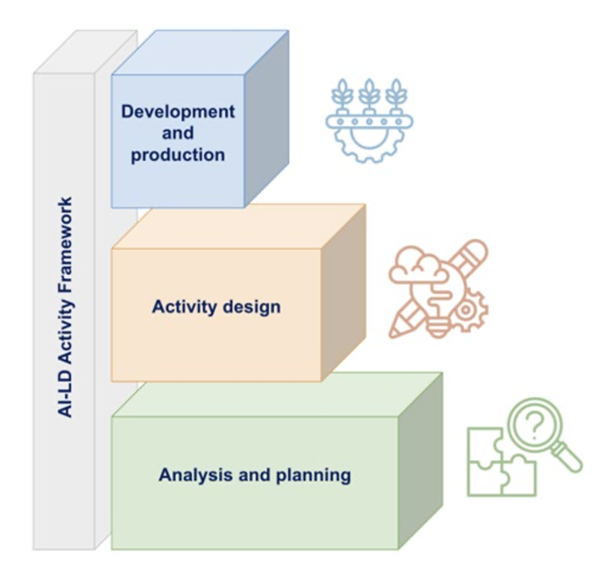
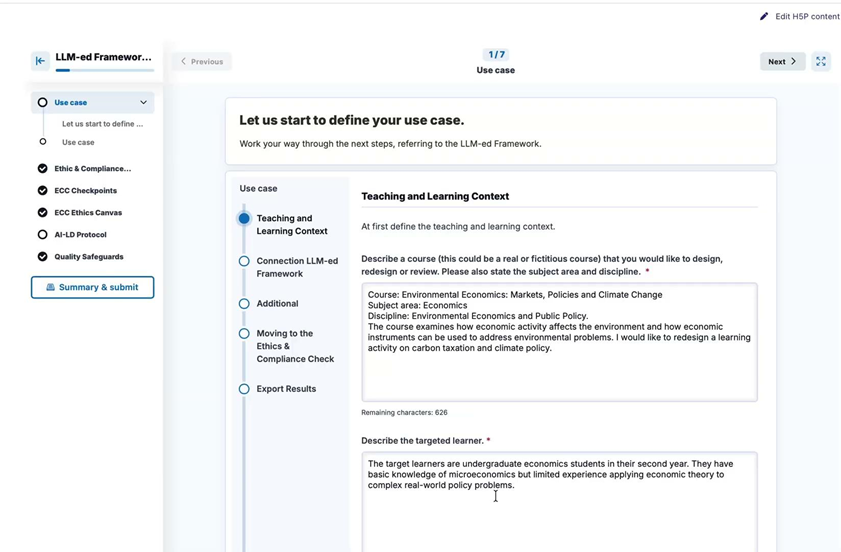
Diagram of the AI-LD Framework (top) and the Toolkit (detail, bottom) implemented in the course.
A promising pilot project that highlights necessary improvements
The intervention incorporated preliminary results from a pilot study involving university faculty and experts in distributed learning design, comprising 15 work sessions—nine individual and six in groups. Feedback indicates a positive perception of the framework’s and toolkit’s utility. Participants highlighted that the tools helped them link AI-based tasks to established pedagogical approaches, clarify responsibilities, and address ethical risks.
Feedback regarding ease of use was more varied. At this stage, the tools had been tested via a prototype spread across multiple presentations and documents, requiring users to consult materials in various locations. Pilot feedback highlighted the need to streamline the workflow, provide discipline-specific examples, and offer brief training to familiarize users with the tools. These observations have guided the development of a more integrated and interactive version, which is now incorporated into the course to be offered (see illustration above).
Maina concluded her remarks by identifying questions that still require investigation. These include whether designs assisted by these tools effectively improve student learning outcomes, engagement, and self-regulation; what forms of collaboration between teachers and AI yield the best designs; and how the sustained use of AI influences teachers’ judgment, creativity, and professional autonomy.
The work presented in the webinar thus proposes a way to incorporate generative AI into educational design through well-founded pedagogical decisions, clear responsibilities, and a critical review of the results.
Other presentations during the webinar broadened the perspective on assessment, governance, and ethics. One of these, delivered by Rafael Vargas from UNED, delved into the results of various ADMIT workstreams: a review of 147 studies on the use of language models in higher education; an analysis of institutional policies and their implementation criteria; and two studies on practices at partner universities, allowing for an observation of their evolution between 2024 and 2025. These efforts raised questions regarding how to adapt assessment to the growing use of AI and how to translate institutional guidelines into actionable decisions for teaching. The presentation on ethics, given by Bhoomika Agarwal from Open Universiteit, outlined a taxonomy developed within ADMIT that organizes the responsible use of generative AI into eight dimensions: educational impact and academic integrity; privacy and data management; social and environmental well-being; teacher and student autonomy; diversity and equity; accountability; transparency; and technical robustness and safety. It also demonstrated how these principles are incorporated into a self-assessment tool and linked this work to the ETHICAI project.