New article with IADE project results! How to integrate artificial intelligence and data literacy in ESO
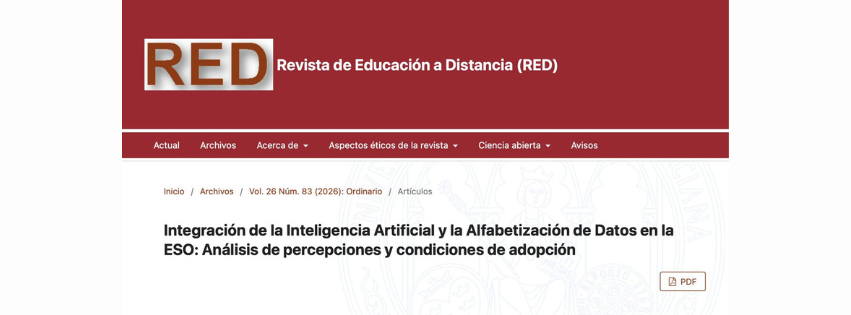
Researchers from the Edul@b Research Group, Dr. Lourdes Guàrdia and Dr. Ludovica Fanni, together with Dr. Daniel Amo Filvà (La Salle-Universitat Ramón Llull) and researchers from the Open University of Catalonia, Dr. Belén Donate Beby and Dr. Guillermo Bautista Pérez, have published a new article on how to integrate artificial intelligence and data literacy in the ESO educational stage entitled: “Integration of Artificial Intelligence and Data Literacy in ESO: Analysis of perceptions and adoption conditions”.
The study presents the results of the third phase of the IADE project (Integration of Artificial Intelligence and Data Literacy in Education), which has the participation of several Edul@b researchers: Dr. Lourdes Guàrdia, Dr. Marcelo Maina, Dr. Nati Cabrera and Dr. Ludovica Fanni. The project aims to establish principles and formulate teaching methodological proposals applicable to the design of practices and activities that facilitate meaningful learning and an assessment model oriented towards active learning, making ethical use of artificial intelligence and learning analytics.
Below, you will find a broad description of the study “Integration of Artificial Intelligence and Data Literacy in ESO: Analysis of perceptions and conditions of adoption”, also a link to the full article, published in Revista de Educación a Distancia (RED) of the Universidad de Murcia.
Description
This study, using a sequential explanatory mixed design, presents the results of the third phase of the IADE project, focused on analyzing Data Literacy (DL) for the use of Learning Analytics (LA) and the adoption of Artificial Intelligence (AI) among secondary education teachers in Catalonia. The quantitative phase included a validated questionnaire that was administered to teachers from different educational centers and from which 372 responses were collected, the results of which reveal low and homogeneous levels of use of LA, as well as an incipient adoption of AI tools. The qualitative phase, developed through a discussion group with professionals from different institutional profiles, allowed the identification of nine categories that describe the barriers, needs and conditions of use of data and AI in educational centers.
The results show an eminently reactive data management, absence of clear institutional frameworks, exploratory and non-systematic use of AI and a strong concern for privacy and procedural coherence. Data triangulation reinforces the need for educational policies that strengthen teacher training, institutional leadership and the ethical and contextualized adoption of AI. The study offers implications for the design of training strategies, regulatory frameworks and accompanying actions that favor a meaningful integration of AI and AD for the use of AA in secondary education.
Full article (Spanish)
How to cite this article
Amo-Filvà, D., Guàrdia, L., Donate Beby, B., Bautista Pérez, G., & Fanni, L. (2026). Integración de la Inteligencia Artificial y la Alfabetización de Datos en la ESO: Análisis de percepciones y condiciones de adopción. Revista De Educación a Distancia (RED), 26(83).